Friday, June 26, 2009

And now a word from our sponsor...


OK, I found a link to this ad for Blackberries off the Phillies website.

Ad for Blackberry

It's cute, and has a historical theme. But what I find interesting is how the ad plays off the expectation of ignorance on the part of the viewer. Although recent evidence suggests that skilled craftsmen were more common than slaves on the pyramid construction sites, it's a little glaring to overlook them (imagine an ad campaign set int he antebellum south without reference to slavery). And nowhere does it suggest that the pyramids were tombs. (There's even a moment where the Pharoah synchs his calendar with that of the foreman: "The boss is coming tomorrow! Get those last stones in place." My response was "Wow, those pharoahs must have been organized to schedule their own deaths like that.").

Of course, my main reaction to the premise ("What if the ancient Egyptians had Blackberries?") is not "Gosh, they would have been able to build a lot more," but "Wow, I bet they would have wasted a lot of time on Facebook."

Thursday, June 25, 2009

Politics & Sex

So the great governor of SC is the latest in a long line of elected officials who have committed sexual peccadilloes. How "wonderful" is it to know that he is yet one more transgressor in the world ruled by "family values?" As a Congressman, Sanford was "morally outraged" by Clinton's transgressions and voted for impeachment (and does everyone remember what Newt Gingrich did and how he voted?). I would argue that the origins of our hyper-partisanship began with the misguided impeachment move by the Republicans against Clinton. Does anyone remember what the special prosecutor was empowered to investigate? Whitewater investments in Arkansas; NOT a cum stained dress worn by Monica Lewinsky.

Back in the gold old days our country was not hurt by the extracurricular activities of either FDR or JFK. But then along came the Moral Majority and their successors and now too many Americans hyperventilate over extramarital affairs. I don't care! Just be a good conservative, moderate, or liberal and represent us on important issues involving the economy and foreign affairs. Stay out of our bedrooms!! But I do get a good laugh every time one of the Republicans wearing the family values banner takes a hit because it will hopefully move us that much closer to ditching that old canard.

Tuesday, June 23, 2009

Iran vs. Tiananmen Square

Several news outlets have drawn comparisons between the current Iranian opposition movement and the Chinese students who took to the streets in 1989. Most clumsily use "Tiananmen Square" as a metaphor for "government crackdown on popular protests." Some, like THIS PIECE from NPR delve a little deeper.

In light of the virulent criticism of Obama's response to the situation (where were these proponents of "universal American values" when were were fixing electrodes to testicles?), I offer our own revolution as a lens through which to view Obama's restraint. France, easily the world's most powerful nation in 1776, waited two years before throwing its open support behind the colonists' revolt against the British crown, despite a historical rivalry with Great Britain. They waited to see if the new government and its fledgling army could stand up on its own first.

Imagine if the French had landed troops on July 5, 1776. How would that have changed global perception of the new country? How would the treaties have ended the war have been different if French intervention had been the backbone of the American army from almost the outset of the war? Domestically, how would Americans' view of their own government have been weakened by the perception that their revolution was in no small part the work of a superpower half a world away? Historically, support for France created deep divisions in the young republic. If there were even more cause to doubt the loyalties of politicians like Jefferson, how much more bitter would the infancy of American politics have been!

So take your time, Mr. President. Give the Iranians the chance our Founding Fathers had to control their destiny.

Sunday, June 14, 2009

Yes, The Gilded Age IS important!

Since the mid 1980s and the rise of Ronald Reagan, I have been making a case with my students that we are living through a new era of "Gilded Age Redux." I have remained comfortable with that formulation and have persisted with it right through to the present. I still see no reason to back away from the argument and it is one of several reasons why I believe it is important to be teaching the Gilded Age in the junior year.

Here is a new NYT Book Review that supports my contention:
June 14, 2009

American Macho

REBIRTH OF A NATION

The Making of Modern America, 1877-1920

By Jackson Lears

Illustrated. 418 pp. Harper/HarperCollins Publishers. $27.99

On March 11, 2003, about a week before President George W. Bush began bombing Iraq, the cultural historian Jackson Lears published an Op-Ed article in The New York Times pleading for sanity. He sensed that it was already too late, and suggested that war opponents might be “fingering a rabbit’s foot from time to time.” As a historian, however, Lears couldn’t help asking when the “regenerative” impulse to seek national glory through war first took root. The result is “Rebirth of a Nation,” a fascinating cultural history that locates the origins of Bush-era belligerence in the anxieties and modernizing impulses of the late 19th century.

Lears describes his bookas a “synthetic reinterpretation” of the Gilded Age and Progressive Era, an effort to dislodge classics like Richard Hofstadter’s “Age of Reform”(1955) and Robert Wiebe’s “Search for Order, 1877-1920”(1967). It’s an ambitious project; both books, despite legions of critics, have shown remarkable staying power. Fortunately, Lears is well qualified for the task. One of the deans of American cultural history (as well as a professor at Rutgers University), Lears has spent decades writing about turn-of-the-20th-century debates over consumerism, modernity, religion and market capitalism. With “Rebirth of a Nation,” he expands his vision to include politics, war and the presidency as well.

The book’s title — a play on D. W. Griffith’s 1915 film “The Birth of a Nation” — suggests two of Lears’s greatest revisionist concerns: the lasting influence of Civil War violence and “the rising significance of race.” Beginning in the 1870s, he argues, Americans attempted to stitch their country back together around a “militarist fantasy” of Anglo-Saxon supremacy. Yet rather than bringing the hoped-for personal and national redemption, their efforts produced tragedy. According to Lears, the same cultural logic that justified lynching in the American South and the conquest of American Indians in the West eventually led to war in Cuba, the Philippines and Europe — and, a century later, to our own mess in Iraq.

Lears is hardly the first scholar to address these themes. But he is among the most far-reaching, seeking to redefine an era known for its reformist energies as a time when militarism and racismall too often triumphed over more pacific, democratic ideals. Like any good synthesis, “Rebirth of a Nation”dutifully covers the major trends of the age: the rise of industrial capitalism, the expansion of American empire, the tightening chokehold of Jim Crow. What brings new life to this material is the book’s emphasis on how Americans’ “inner lives” came to shape their outer worlds. Events that appear to be struggles for conquest and plunder turn out, in Lears’s view, to be animated by a personal search for meaning. “The rise of total war between the Civil War and World War I was rooted in longings for release from bourgeois normality into a realm of heroic struggle,” he writes. “This was the desperate anxiety, the yearning for rebirth, that lay behind official ideologies of romantic nationalism, imperial progress and civilizing mission — and that led to the trenches of the Western Front.”

This approach can exaggerate the impact of culture (great-power diplomacy, too, led to the trenches). But “Rebirth of a Nation” captures something undeniably powerful about the nation’s psychic crisis as it recovered from the wounds of civil war. The late 19th century brought vast change at nearly every level of culture and society, from the growth of white-collar employment to the dislocations of mass immigration and urbanization. This crisis was particularly acute for white men, who found their traditional sources of power and identity challenged at every turn. In response, Lears writes, they turned to solutions ranging from the muscular Christianity of the Y.M.C.A. to the Populist struggle for self-determination to bloody conflicts on the battlefield.

Lears’s “poster boy” for this aggressive new masculinity is Teddy Roosevelt, whose blend of boosterism, progressivism and unabashed imperialism captured both its high ideals and serious dangers. Like so many reformers, Roosevelt sought to remake American society along more equitable and democratic lines. At the same time, he believed that Anglo-Saxon men possessed a God-given right to dominate the world. In both cases, Lears suggests, Roosevelt’s politics were the product of a profound internal struggle. “There must be control,” Roosevelt wrote in the 1890s. “There must be mastery, somewhere, and if there is no self-control and self-mastery, the control and the mastery will ultimately be imposed from without.” He was writing to Rudyard Kipling about the problem of governing “dark-hued” peoples, but he might as well have been writing about his own psyche.

While Roosevelt serves as the book’s protagonist, its pages are filled with lively portraits of other period figures, from the escape artist Harry Houdini to the settlement house worker and peace activist Jane Addams. Lears uses these men and women as exemplars of broad cultural trends: Houdini transformed magic “from spiritualism to strenuousness”; Addams represented “an alternative to militarism for romantic young professionals.” “Rebirth of a Nation” also includes glimpses of humbler Americans eking out lives at the margins of the era’s great conflicts. In one moving section, Lears recounts the story of Emily French, a “hard-worked woman,” in her words, whose abandonment by her husband left her nearly destitute (and who happened to keep a detailed diary of her struggles).

At times, it’s not quite clear how these disparate figures all fit into the theme of “rebirth,” a concept at once highly specific and conveniently broad. In addition, Lears never satisfyingly explains why the brutality of the Civil War spawned dreams of heroics, while World War I produced a consensus that American soldiers were “dying in vain.” But these are minor quibbles. “Rebirth of a Nation”is a major work by a leading historian at the top of his game — at once engaging and tightly argued. Like the best histories, it is also a book that speaks to our own time.

In his conclusion, Lears explicitly identifies Roosevelt as George W. Bush’s true “ideological ancestor,” a rebuttal to those who would place the universalist Woodrow Wilson first in the Iraq war’s genealogy. Still, it’s on the subject of economic culture — long a staple of Lears’s work — that “Rebirth of a Nation”delivers its most pointed critique. Lears completed his manuscript before the current financial crisis, and before the Obama administration came to power advertising its own message of “rebirth.” His descriptions of budding American consumerism nonetheless resonate strongly with present-day concerns.

In his chapter on “The Mysterious Power of Money,” Lears quotes Mark Twain satirizing the excesses of the first Gilded Age: “Beautiful credit! The foundation of modern society. Who shall say that this is not the golden age of mutual trust, of unlimited reliance upon human promises?” The reality, Lears reminds us, was far less glamorous. “A great deal of waste, fraud and corruption went into the making of the modern American economy,” he writes in a description that might be transferred wholesale to our own Gilded Age, “and much of it was concentrated on Wall Street.”

Beverly Gage, a history professor at Yale, is the author of “The Day Wall Street Exploded: A Story of America in Its First Age of Terror.”

Crying "Fire" in a Movie Theater...

I normally fall down on the libertarian side of free speech. I will normally argue that there is always a danger in limiting speech. That is why I have never agreed with the liberal political correctness mode. The Neo-Nazis were correctly permitted to march in Skokie, IL. Anti-war demonstrators should be able to burn the U.S. flag. But when does hate speech cross the line into the Supreme Court's test of "yelling fire in a movie theater?"

Frank Rich has laid out an interesting argument that the leaders within the Republican Party are irresponsibly remaining silent when people like Glen Beck uses Nazi stormtrooper archive footage as a back drop when criticizing Obama. Or when Rush Limbaugh charges that our impending Supreme Court justice is a racist and that liberals are responsible for the white supremacist murder in the National Holocaust Museum. Though I find Fox News to be a legitimate conservative voice, when you have a million + viewership or listenership (ala Rush), does it increase the possibilities for the incitement of murder? It seems to me that the Republican Party that I have admired in the past is treading on some very thin ice here....

June 14, 2009
OP-ED COLUMNIST

The Obama Haters’ Silent Enablers

WHEN a Fox News anchor, reacting to his own network’s surging e-mail traffic, warns urgently on-camera of a rise in hate-filled, “amped up” Americans who are “taking the extra step and getting the gun out,” maybe we should listen. He has better sources in that underground than most.

The anchor was Shepard Smith, speaking after Wednesday’s mayhem at the United States Holocaust Memorial Museum in Washington. Unlike the bloviators at his network and elsewhere on cable, Smith is famous for his highly caffeinated news-reading, not any political agenda. But very occasionally — notably during Hurricane Katrina — he hits the Howard Beale mad-as-hell wall. Joining those at Fox who routinely disregard the network’s “We report, you decide” mantra, he both reported and decided, loudly.

What he reported was this: his e-mail from viewers had “become more and more frightening” in recent months, dating back to the election season. From Wednesday alone, he “could read a hundred” messages spewing “hate that’s not based in fact,” much of it about Barack Obama and some of it sharing the museum gunman’s canard that the president was not a naturally born citizen. These are Americans “out there in a scary place,” Smith said.

Then he brought up another recent gunman: “If you’re one who believes that abortion is murder, at what point do you go out and kill someone who’s performing abortions?” An answer, he said, was provided by Dr. George Tiller’s killer. He went on: “If you are one who believes these sorts of things about the president of the United States ...” He left the rest of that chilling sentence unsaid.

These are extraordinary words to hear on Fox. The network’s highest-rated star, Bill O’Reilly, had assailed Tiller, calling him “Tiller the baby killer” and likening him to the Nazis, on 29 of his shows before the doctor was murdered at his church in Kansas. O’Reilly was unrepentant, stating that only “pro-abortion zealots and Fox News haters” would link him to the crime. But now another Fox star, while stopping short of blaming O’Reilly, was breaching his network’s brand of political correctness: he tied the far-right loners who had gotten their guns out in Wichita and Washington to the mounting fury of Obama haters.

What is this fury about? In his scant 145 days in office, the new president has not remotely matched the Bush record in deficit creation. Nor has he repealed the right to bear arms or exacerbated the wars he inherited. He has tried more than his predecessor ever did to reach across the aisle. But none of that seems to matter. A sizable minority of Americans is irrationally fearful of the fast-moving generational, cultural and racial turnover Obama embodies — indeed, of the 21st century itself. That minority is now getting angrier in inverse relationship to his popularity with the vast majority of the country. Change can be frightening and traumatic, especially if it’s not change you can believe in.

We don’t know whether the tiny subset of domestic terrorists in this crowd is egged on by political or media demagogues — though we do tend to assume that foreign jihadists respond like Pavlov’s dogs to the words of their most fanatical leaders and polemicists. But well before the latest murderers struck — well before another “antigovernment” Obama hater went on a cop-killing rampage in Pittsburgh in April — there have been indications that this rage could spiral out of control.

This was evident during the campaign, when hotheads greeted Obama’s name with “Treason!” and “Terrorist!” at G.O.P. rallies. At first the McCain-Palin campaign fed the anger with accusations that Obama was “palling around with terrorists.” But later John McCain thought better of it anddefended his opponent’s honor to a town-hall participant who vented her fears of the Democrats’ “Arab” candidate. Although two neo-Nazi skinheadswere arrested in an assassination plot against Obama two weeks before Election Day, the fever broke after McCain exercised leadership.

That honeymoon, if it was one, is over. Conservatives have legitimate ideological beefs with Obama, rightly expressed in sharp language. But the invective in some quarters has unmistakably amped up. The writer Camille Paglia, a political independent and confessed talk-radio fan, detected a shift toward paranoia in the air waves by mid-May. When “the tone darkens toward a rhetoric of purgation and annihilation,” she observed in Salon, “there is reason for alarm.” She cited a “joke” repeated by a Rush Limbaugh fill-in host, a talk-radio jock from Dallas of all places, about how “any U.S. soldier” who found himself with only two bullets in an elevator with Nancy Pelosi, Harry Reid and Osama bin Laden would use both shots to assassinate Pelosi and then strangle Reid and bin Laden.

This homicide-saturated vituperation is endemic among mini-Limbaughs. Glenn Beck has dipped into O’Reilly’s Holocaust analogies to liken Obama’s policy on stem-cell research to the eugenics that led to “the final solution” and the quest for “a master race.” After James von Brunn’s rampage at the Holocaust museum, Beck rushed onto Fox News to describe the Obama-hating killer as a “lone gunman nutjob.” Yet in the same show Beck also said von Brunn was a symptom that “the pot in America is boiling,” as if Beck himself were not the boiling pot cheering the kettle on.

But hyperbole from the usual suspects in the entertainment arena of TV and radio is not the whole story. What’s startling is the spillover of this poison into the conservative political establishment. Saul Anuzis, a former Michigan G.O.P. chairman who ran for the party’s national chairmanship this year, seriously suggested in April that Republicans should stop calling Obama a socialist because “it no longer has the negative connotation it had 20 years ago, or even 10 years ago.” Anuzis pushed “fascism” instead, because “everybody still thinks that’s a bad thing.” He didn’t seem to grasp that “fascism” is nonsensical as a description of the Obama administration or that there might be a risk in slurring a president with a word that most find “bad” because it evokes a mass-murderer like Hitler.

The Anuzis “fascism” solution to the Obama problem has caught fire. The president’s nomination of Sonia Sotomayor to the Supreme Court and his speech in Cairo have only exacerbated the ugliness. The venomous personal attacks on Sotomayor have little to do with the 3,000-plus cases she’s adjudicated in nearly 17 years on the bench or her thoughts about the judgment of “a wise Latina woman.” She has been tarred as a member of “the Latino KKK” (by the former Republican presidential candidate Tom Tancredo), as well as a racist and a David Duke (by Limbaugh), and portrayed, in a bizarre two-for-one ethnic caricature, as a slant-eyed Asian on the cover of National Review. Uniting all these insults is an aggrieved note of white victimization only a shade less explicit than that in von Brunn’s white supremacist screeds.

Obama’s Cairo address, meanwhile, prompted over-the-top accusations reminiscent of those campaign rally cries of “Treason!” It was a prominent former Reagan defense official, Frank Gaffney, not some fringe crackpot, who accused Obama in The Washington Times of engaging “in the most consequential bait-and-switch since Adolf Hitler duped Neville Chamberlain.” He claimed that the president — a lifelong Christian — “may still be” a Muslim and is aligned with “the dangerous global movement known as the Muslim Brotherhood.” Gaffney linked Obama by innuendo with Islamic “charities” that “have been convicted of providing material support for terrorism.”

If this isn’t a handy rationalization for another lone nutjob to take the law into his own hands against a supposed terrorism supporter, what is? Any such nutjob can easily grab a weapon. Gun enthusiasts have been on a shopping spree since the election, with some areas of our country reporting percentage sales increases in the mid-to-high double digits, recession be damned.

The question, Shepard Smith said on Fox last week, is “if there is really a way to put a hold on” those who might run amok. We’re not about to repeal the First or Second Amendments. Hard-core haters resolutely dismiss any “mainstream media” debunking of their conspiracy theories. The only voices that might penetrate their alternative reality — I emphasize might — belong to conservative leaders with the guts and clout to step up as McCain did last fall. Where are they? The genteel public debate in right-leaning intellectual circles about the conservative movement’s future will be buried by history if these insistent alarms are met with silence.

It’s typical of this dereliction of responsibility that when the Department of Homeland Security released a plausible (and, tragically, prescient) report about far-right domestic terrorism two months ago, the conservative response was to trash it as “the height of insult,” in the words of the G.O.P. chairman Michael Steele. But as Smith also said last week, Homeland Security was “warning us for a reason.”

No matter. Last week it was business as usual, as Republican leaders nattered ad infinitum over the juvenile rivalry of Sarah Palin and Newt Gingrichat the party’s big Washington fund-raiser. Few if any mentioned, let alone questioned, the ominous script delivered by the actor Jon Voight with the G.O.P. imprimatur at that same event. Voight’s devout wish was to “bring an end to this false prophet Obama.”

This kind of rhetoric, with its pseudo-Scriptural call to action, is toxic. It is getting louder each day of the Obama presidency. No one, not even Fox News viewers, can say they weren’t warned.


Reagan Reconsidered

In today's NYT Week in Review section appears "Republicans Rethinking the Reagan Mystique." It is an interesting report about how some Republicans think that their future does not point in the direction that Reagan so successfully led his party back in the 1980s. Of particular interest is Gov. Mitch Daniels' comments, since he worked in the Reagan White House. I find it a bit ironic that President Obama may be the one leaning toward a Reagan-like White House rather than new Republican leaders standing off stage. So, I watch with curiosity as the Republicans struggle to redefine themselves. A follow-up post that I will make certainly will suggest that the strident voice within their party is something that so far the Republicans have failed to come to grips with, in my opinion.

June 14, 2009

Republicans Rethinking the Reagan Mystique

For a liberal Democrat, President Obama has offered generous praise for the most celebrated of his recent Republican predecessors.

Mr. Obama has credited Ronald Reagan with having “changed the trajectory of America” in ways Bill Clinton didn’t. “President Reagan helped as much as any president to restore a sense of optimism in our country, a spirit that transcended politics,” Mr. Obama said earlier this month while signing the Ronald Reagan Centennial Commission Act in the presence of Nancy Reagan.

It’s not surprising that Mr. Obama has embraced Mr. Reagan’s achievement since it seems akin to his own aspirations and might also ingratiate him with conservatives. What is surprising is the increasingly ambiguous position Mr. Reagan holds on the right.

Some Republicans have begun reassessing whether Mr. Reagan today affords the best example as they seek a path back to power. The economic crisis, which Mr. Obama last fall declared a “final verdict” on the anti-government philosophy that George W. Bush and Mr. Reagan shared, has made Reaganism less politically marketable than at any time in a generation.

“I don’t use him publicly as a reference point,” said Gov. Mitch Daniels of Indiana, a Republican who lately has emerged as a potential national party leader. Mr. Daniels instead has urged fellow Republicans to “let go” of Mr. Reagan as a contemporary symbol.

As Mr. Reagan’s White House political director, Mr. Daniels brings credibility to the discussion. A year ago, when he first proposed that Republicans turn the page he drew sharp criticism from Rush Limbaugh, among others. Now, Mr. Daniels observes, “I think it’s spreading.”

That’s not to say Republicans disavow Mr. Reagan’s achievements, which include cutting tax rates, presiding over the successful conclusion of the cold war and, as Mr. Obama noted, boosting morale after a period of national self-doubt. Indeed a recent video made by a conservative group includesNewt Gingrich invoking Mr. Reagan in the terms of old: “His rendezvous with destiny is a reminder that we all have a similar rendezvous,” Mr. Gingrich said, reflecting the admiration for Mr. Reagan that is still in force among the party’s conservative base.

Mr. Daniels, too, hails his former boss for “timeless” principles like suspicion of big government and appreciation of the importance of individual freedom and opportunity. As he tackles issues in Indiana — education policy lately is a hot topic — he says he asks himself whether Mr. Reagan would approve.

But “Reagan always faced forward,” the governor said. “If he were around, he’d tell Republicans to do that now. He’d be the last to want the focus on him.”

What’s needed instead, said Reihan Salam, co-author of “Grand New Party: How Republicans Can Win the Working Class and Save the American Dream,” is “something new — the anti-Obama, anti-Reagan.” Mr. Salam, whose co-author is Ross Douthat, an Op-Ed columnist for The New York Times, was born in 1979 — a year before Mr. Reagan was elected to his first term. Mr. Salam said he favored a new prototype of Republican leadership that projected humility rather than grandeur, understated competence rather than soaring rhetoric and vision.

Much has changed since the 2008 campaign, when the Republican contenders all were openly competing to be Mr. Reagan’s true heir. In one debate,Fred Thompson invoked Mr. Reagan on tax cuts; Mitt Romney hailed him for championing “our military,’ “our economy” and “our family values”; while John McCain linked “my dear and beloved Ronald Reagan” with his own support for free trade.

In accepting the nomination, Mr. McCain branded Republicans as the party of three heroes: Abraham Lincoln, Theodore Roosevelt and Mr. Reagan. In this he followed George W. Bush, who in 2004 pointed to Mr. Reagan rather than his own father as the president whose spirit “will always define our party.”

At the time it wasn’t hard to see why. Republicans have long viewed Mr. Reagan’s presidency as vastly more successful than that of the elder Mr. Bush — or any other recent Republican president. And the public seemed to agree.

Mr. Reagan’s approval ratings rose sharply after he left office — from 53 percent in 1988, at the end of his time in office, to 73 percent by 2002, according to Gallup. But it’s not clear the Reagan election model can work in the 21st century, as America’s population has become more diverse. In 1980, Mr. Reagan thrashed Jimmy Carter by winning 55 percent of the white vote. Mr. McCain, as it happens, matched that percentage in 2008, but lost decisively to Mr. Obama. The difference, according to exit polls, is that whites represented 74 percent of the overall electorate last year, down from 88 percent in 1980. At the same time, blacks and Hispanics collectively accounted for 22 percent of the vote in 2008, up from 12 percent in 1980.

But demographics tell only part of the story. There is also the arrival of a new slate of pressing issues. It has been 20 years since Mr. Reagan’s plea to “tear down that wall” was answered by the fall of Communism. The 70 percent top income tax rate Mr. Reagan called confiscatory now stands at half that level. And the cultural appeals he made to blue-collar voters and evangelicals have lost their immediacy, displaced by economic concerns. Many remember that Mr. Reagan identified government as “the problem.” But today an increasing number of voters look to the government for security and stability.

Perhaps most important, the principal early line of attack Republicans have offered against Mr. Obama, that he is a profligate spender who will run up massive deficits, is also the area where the Reagan Revolution looks most vulnerable today, as critics on the right have pointed out. “The federal payroll was larger in 1989 than it had been in 1981,” Richard Gamble wrote last month in American Conservative magazine. “Reagan’s tax cuts, whatever their merits as short-term fiscal policy, left large and growing budget deficits when combined with increased spending, and added to the national debt.”

To be sure, Mr. Reagan’s failure to curb the cost of government reflected the enduring difficulty all presidents face in balancing the government services Americans want with the taxes they’re willing to pay. But today it seems, increasingly, that it was Mr. Reagan and his admirer, George W. Bush, who contributed most to the problem of runaway spending, at least among recent presidents.

Some Republican critics also now point to shortcomings in Mr. Reagan’s governing style. “The most dangerous legacy Reagan bequeathed his party was his legacy of cheerful indifference to detail,” the conservative thinker David Frum wrote in his recent book, “Comeback: Conservatism That Can Win Again.” “The next Republican president needs to master details, understand his options and make his decisions with care.”

Meanwhile, Democrats embrace the possibility that it is Mr. Obama who may duplicate Mr. Reagan’s political triumphs: restoring luster to the presidency after an unpopular predecessor and also fundamentally shifting the direction of American politics.

“They came at the end of a period of one-party hegemony,” David Axelrod, Mr. Obama’s chief political adviser, said of his boss and of Mr. Reagan. “Both of them were major candidates of change.”


Saturday, June 13, 2009

Conservatives in Academia

Having sometimes argued that there's a distinct difference between "hearing both sides" from a group of overwhelmingly liberal teachers and actually hearing both sides, I found the following to be of interest, and a challenge to that claim. The author (a prominent conservative) argues for a balanced approach to presenting liberal and conservative ideas, but rejects the idea that affirmative action should apply to the hiring of conservative faculty. I'm inclined to agree with him.

JUNE 13, 2009
Wall Street Journal
Conservatism and the University Curriculum
If they can find time for feminist theory, they can find time for Edmund Burke.

By PETER BERKOWITZ
The political science departments at elite private universities such as Harvard and Yale, at leading small liberal arts colleges like Swarthmore and Williams, and at distinguished large public universities like the University of Maryland and the University of California, Berkeley, offer undergraduates a variety of courses on a range of topics. But one topic the undergraduates at these institutions -- and at the vast majority of other universities and colleges -- are unlikely to find covered is conservatism.

There is no legitimate intellectual justification for this omission. The exclusion of conservative ideas from the curriculum contravenes the requirements of a liberal education and an objective study of political science.

Political science departments are generally divided into the subfields of American politics, comparative politics, international relations, and political theory. Conservative ideas are relevant in all four, but the obvious areas within the political science discipline to teach about the great tradition of conservative ideas and thinkers are American politics and political theory. That rarely happens today.

To be sure, a political science department may feature a course on American political thought that includes a few papers from "The Federalist" and some chapters from Alexis de Tocqueville's "Democracy in America."

But most students will hear next to nothing about the conservative tradition in American politics that stretches from John Adams to Theodore Roosevelt to William F. Buckley Jr. to Milton Friedman to Ronald Reagan. This tradition emphasizes moral and intellectual excellence, worries that democratic practices and egalitarian norms will threaten individual liberty, attends to the claims of religion and the role it can play in educating citizens for liberty, and provides both a vigorous defense of free-market capitalism and a powerful critique of capitalism's relentless overturning of established ways. It also recognized early that communism represented an implacable enemy of freedom. And for 30 years it has been animated by a fascinating quarrel between traditionalists, libertarians and neoconservatives.

While ignoring conservatism, the political theory subfield regularly offers specialized courses in liberal theory and democratic theory; African-American political thought and feminist political theory; the social theory of Karl Marx, Emile Durkheim, Max Weber and the neo-Marxist Frankfurt school; and numerous versions of postmodern political theory.

Students may encounter in various political theory courses an essay by the British historian and philosopher Michael Oakeshott, or a chapter from a book by the German-born American political philosopher Leo Strauss. But they will learn very little about the constellation of ideas and thinkers linked in many cases by a common concern with the dangers to liberty that stem from the excesses to which liberty and equality give rise.

That constellation begins to come into focus at the end of the 18th century with Edmund Burke's "Reflections on the Revolution in France." It draws on the conservative side of the liberal tradition, particularly Adam Smith and David Hume and includes Tocqueville's great writings on democracy and aristocracy and John Stuart Mill's classical liberalism. It gets new life in the years following World War II from Friedrich Hayek's seminal writings on liberty and limited government and Russell Kirk's reconstruction of traditionalist conservatism. And it is elevated by Michael Oakeshott's eloquent reflections on the pervasive tendency in modern politics to substitute abstract reason for experience and historical knowledge, and by Leo Strauss's deft explorations of the dependence of liberty on moral and intellectual virtue.

Without an introduction to the conservative tradition in America and the conservative dimensions of modern political philosophy, political science students are condemned to a substantially incomplete and seriously unbalanced knowledge of their subject. Courses on this tradition should be mandatory for students of politics; today they are not even an option at most American universities.

When progressives, who dominate the academy, confront arguments about the need for the curriculum to give greater attention to conservative ideas, they often hear them as a demand for affirmative action. Usually they mishear. Certainly affirmative action for conservatives is a terrible idea.

Political science departments should not seek out professors with conservative political opinions. Nor should they lower scholarly standards. That approach would embrace the very assumption that has corrupted liberal education: that to study and teach particular political ideas one's identity is more important than the breadth and depth of one's knowledge and the rigor of one's thinking.

One need not be a Puritan to study and teach colonial American religious thought, an ancient Israelite to study and teach biblical thought, or a conservative or Republican to study and teach conservative ideas. Affirmative action in university hiring for political conservatives should be firmly rejected, certainly by conservatives and defenders of liberal education.

To be sure, if political science departments were compelled to hire competent scholars to offer courses on conservative ideas and conservative thinkers, the result would be more faculty positions filled by political conservatives, since they and not progressives tend to take an interest in studying conservative thought. But there is no reason why scholars with progressive political opinions and who belong to the Democratic Party can not, out of a desire to understand American political history and modern political philosophy, study and teach conservatism in accordance with high intellectual standards. It would be good if they did.

It would also be good if every political science department offered a complementary course on the history of progressivism in America. This would discourage professors from conflating American political thought as a whole with progressivism, which they do in a variety of ways, starting with the questions they tend to ask and those they refuse to entertain.
Incorporating courses on conservatism in the curriculum may, as students graduate, disperse, and pursue their lives, yield the political benefit of an increase in mutual understanding between left and right. In this way, reforming the curriculum could diminish the polarization that afflicts our political and intellectual classes. But that benefit is admittedly distant and speculative.

In the near term, giving conservative ideas their due will have the concrete and immediate benefit of advancing liberal education's proper and commendable goal, which is the formation of free and well-furnished minds.

Mr. Berkowitz is a senior fellow at Stanford University's Hoover Institution.

Thursday, June 11, 2009

Exams in China

Now that we have finished our exams, I found the essay questions of for China's college entrance tests to be interesting in their emphasis on creative and original thought. Here's the link to the questions:

http://www.danwei.org/scholarship_and_education/invisible_wings_2009s_college.php

If I had a pair of invisible wings, I still couldn't write comments any faster and I probably couldn't sit in a chair for a long time because that would be uncomfortable. Damn those wings...

Tuesday, June 9, 2009

They may be right, they may be crazy...

This story, aired on NPR yesterday, was interesting to me for a few reasons. First, I like the fact that the mathematicians and economists profiled have challenged one of the fundamental principles of economics and public policy, that people left to their own devices tend to make rational choices that serve their self-interest. Second, if these guys are right, what are the implications for policy decisions if people cannot be expected to behave rationally. That this new thinking has the ear of the president has me a little concerned. I'm all for government intervention, but if it becomes the norm rather than the exception, based on the premise that we don't know what's best for us (but, presumably, our policy-makers and their economist sidekicks do), we move closer to the totalitarian world that hyperbolic Fox analysts are predicting.

Friday, June 5, 2009

The Good War persists

This struck me as strange:

The following sentence on msn.com began an article on a tragic episode in the lead-up to D-Day where several vessels carrying hundreds of allied troops were sunk by German torpedo boats.

Lured across the English Channel by an unexpected frenzy of radio chatter, the Nazi predators sliced through the waves toward an unknown enemy.

Far be it for me to defend the leadership or goals of Germany in WWII, but it seems more than a little loaded to refer to the German crews of torpedo boats as "Nazis" (I'm guessing that none of the sailors aboard those craft were members of the party) and "predators" (Would American bomber crews be referred to by that term?). Is there any other conflict where we so villify the foot soldiers of our enemy? Does our collective understanding of WWII depend on it being a crusade against evil?

Thursday, June 4, 2009

Obama's Cairo Address

Here's the transcript of President Obama's June 4 address in Cairo:

June 4, 2009, 6:11 AM ET
Obama’s Speech in Cairo

Obama delivered his much-anticipated message to the Muslim world from the auditorium in the Cairo University campus:

Thank you very much. Good afternoon. I am honored to be in the timeless city of Cairo, and to be hosted by two remarkable institutions. For over a thousand years, Al-Azhar has stood as a beacon of Islamic learning; and for over a century, Cairo University has been a source of Egypt’s advancement. And together, you represent the harmony between tradition and progress. I’m grateful for your hospitality, and the hospitality of the people of Egypt. And I’m also proud to carry with me the goodwill of the American people, and a greeting of peace from Muslim communities in my country: Assalaamu alaykum. (Applause.)
We meet at a time of great tension between the United States and Muslims around the world — tension rooted in historical forces that go beyond any current policy debate. The relationship between Islam and the West includes centuries of coexistence and cooperation, but also conflict and religious wars. More recently, tension has been fed by colonialism that denied rights and opportunities to many Muslims, and a Cold War in which Muslim-majority countries were too often treated as proxies without regard to their own aspirations. Moreover, the sweeping change brought by modernity and globalization led many Muslims to view the West as hostile to the traditions of Islam.
Violent extremists have exploited these tensions in a small but potent minority of Muslims. The attacks of September 11, 2001 and the continued efforts of these extremists to engage in violence against civilians has led some in my country to view Islam as inevitably hostile not only to America and Western countries, but also to human rights. All this has bred more fear and more mistrust.
So long as our relationship is defined by our differences, we will empower those who sow hatred rather than peace, those who promote conflict rather than the cooperation that can help all of our people achieve justice and prosperity. And this cycle of suspicion and discord must end.
I’ve come here to Cairo to seek a new beginning between the United States and Muslims around the world, one based on mutual interest and mutual respect, and one based upon the truth that America and Islam are not exclusive and need not be in competition. Instead, they overlap, and share common principles — principles of justice and progress; tolerance and the dignity of all human beings.
I do so recognizing that change cannot happen overnight. I know there’s been a lot of publicity about this speech, but no single speech can eradicate years of mistrust, nor can I answer in the time that I have this afternoon all the complex questions that brought us to this point. But I am convinced that in order to move forward, we must say openly to each other the things we hold in our hearts and that too often are said only behind closed doors. There must be a sustained effort to listen to each other; to learn from each other; to respect one another; and to seek common ground. As the Holy Koran tells us, “Be conscious of God and speak always the truth.” (Applause.) That is what I will try to do today — to speak the truth as best I can, humbled by the task before us, and firm in my belief that the interests we share as human beings are far more powerful than the forces that drive us apart.
Now part of this conviction is rooted in my own experience. I’m a Christian, but my father came from a Kenyan family that includes generations of Muslims. As a boy, I spent several years in Indonesia and heard the call of the azaan at the break of dawn and at the fall of dusk. As a young man, I worked in Chicago communities where many found dignity and peace in their Muslim faith.
As a student of history, I also know civilization’s debt to Islam. It was Islam — at places like Al-Azhar — that carried the light of learning through so many centuries, paving the way for Europe’s Renaissance and Enlightenment. It was innovation in Muslim communities — (applause) — it was innovation in Muslim communities that developed the order of algebra; our magnetic compass and tools of navigation; our mastery of pens and printing; our understanding of how disease spreads and how it can be healed. Islamic culture has given us majestic arches and soaring spires; timeless poetry and cherished music; elegant calligraphy and places of peaceful contemplation. And throughout history, Islam has demonstrated through words and deeds the possibilities of religious tolerance and racial equality. (Applause.)
I also know that Islam has always been a part of America’s story. The first nation to recognize my country was Morocco. In signing the Treaty of Tripoli in 1796, our second President, John Adams, wrote, “The United States has in itself no character of enmity against the laws, religion or tranquility of Muslims.” And since our founding, American Muslims have enriched the United States. They have fought in our wars, they have served in our government, they have stood for civil rights, they have started businesses, they have taught at our universities, they’ve excelled in our sports arenas, they’ve won Nobel Prizes, built our tallest building, and lit the Olympic Torch. And when the first Muslim American was recently elected to Congress, he took the oath to defend our Constitution using the same Holy Koran that one of our Founding Fathers — Thomas Jefferson — kept in his personal library. (Applause.)
So I have known Islam on three continents before coming to the region where it was first revealed. That experience guides my conviction that partnership between America and Islam must be based on what Islam is, not what it isn’t. And I consider it part of my responsibility as President of the United States to fight against negative stereotypes of Islam wherever they appear. (Applause.)
But that same principle must apply to Muslim perceptions of America. (Applause.) Just as Muslims do not fit a crude stereotype, America is not the crude stereotype of a self-interested empire. The United States has been one of the greatest sources of progress that the world has ever known. We were born out of revolution against an empire. We were founded upon the ideal that all are created equal, and we have shed blood and struggled for centuries to give meaning to those words — within our borders, and around the world. We are shaped by every culture, drawn from every end of the Earth, and dedicated to a simple concept: E pluribus unum — “Out of many, one.”
Now, much has been made of the fact that an African American with the name Barack Hussein Obama could be elected President. (Applause.) But my personal story is not so unique. The dream of opportunity for all people has not come true for everyone in America, but its promise exists for all who come to our shores — and that includes nearly 7 million American Muslims in our country today who, by the way, enjoy incomes and educational levels that are higher than the American average. (Applause.)
Moreover, freedom in America is indivisible from the freedom to practice one’s religion. That is why there is a mosque in every state in our union, and over 1,200 mosques within our borders. That’s why the United States government has gone to court to protect the right of women and girls to wear the hijab and to punish those who would deny it. (Applause.)
So let there be no doubt: Islam is a part of America. And I believe that America holds within her the truth that regardless of race, religion, or station in life, all of us share common aspirations — to live in peace and security; to get an education and to work with dignity; to love our families, our communities, and our God. These things we share. This is the hope of all humanity.
Of course, recognizing our common humanity is only the beginning of our task. Words alone cannot meet the needs of our people. These needs will be met only if we act boldly in the years ahead; and if we understand that the challenges we face are shared, and our failure to meet them will hurt us all.
For we have learned from recent experience that when a financial system weakens in one country, prosperity is hurt everywhere. When a new flu infects one human being, all are at risk. When one nation pursues a nuclear weapon, the risk of nuclear attack rises for all nations. When violent extremists operate in one stretch of mountains, people are endangered across an ocean. When innocents in Bosnia and Darfur are slaughtered, that is a stain on our collective conscience. (Applause.) That is what it means to share this world in the 21st century. That is the responsibility we have to one another as human beings.
And this is a difficult responsibility to embrace. For human history has often been a record of nations and tribes — and, yes, religions — subjugating one another in pursuit of their own interests. Yet in this new age, such attitudes are self-defeating. Given our interdependence, any world order that elevates one nation or group of people over another will inevitably fail. So whatever we think of the past, we must not be prisoners to it. Our problems must be dealt with through partnership; our progress must be shared. (Applause.)
Now, that does not mean we should ignore sources of tension. Indeed, it suggests the opposite: We must face these tensions squarely. And so in that spirit, let me speak as clearly and as plainly as I can about some specific issues that I believe we must finally confront together.
The first issue that we have to confront is violent extremism in all of its forms.
In Ankara, I made clear that America is not — and never will be — at war with Islam. (Applause.) We will, however, relentlessly confront violent extremists who pose a grave threat to our security — because we reject the same thing that people of all faiths reject: the killing of innocent men, women, and children. And it is my first duty as President to protect the American people.
The situation in Afghanistan demonstrates America’s goals, and our need to work together. Over seven years ago, the United States pursued al Qaeda and the Taliban with broad international support. We did not go by choice; we went because of necessity. I’m aware that there’s still some who would question or even justify the events of 9/11. But let us be clear: Al Qaeda killed nearly 3,000 people on that day. The victims were innocent men, women and children from America and many other nations who had done nothing to harm anybody. And yet al Qaeda chose to ruthlessly murder these people, claimed credit for the attack, and even now states their determination to kill on a massive scale. They have affiliates in many countries and are trying to expand their reach. These are not opinions to be debated; these are facts to be dealt with.
Now, make no mistake: We do not want to keep our troops in Afghanistan. We see no military — we seek no military bases there. It is agonizing for America to lose our young men and women. It is costly and politically difficult to continue this conflict. We would gladly bring every single one of our troops home if we could be confident that there were not violent extremists in Afghanistan and now Pakistan determined to kill as many Americans as they possibly can. But that is not yet the case.
And that’s why we’re partnering with a coalition of 46 countries. And despite the costs involved, America’s commitment will not weaken. Indeed, none of us should tolerate these extremists. They have killed in many countries. They have killed people of different faiths — but more than any other, they have killed Muslims. Their actions are irreconcilable with the rights of human beings, the progress of nations, and with Islam. The Holy Koran teaches that whoever kills an innocent is as — it is as if he has killed all mankind. (Applause.) And the Holy Koran also says whoever saves a person, it is as if he has saved all mankind. (Applause.) The enduring faith of over a billion people is so much bigger than the narrow hatred of a few. Islam is not part of the problem in combating violent extremism — it is an important part of promoting peace.
Now, we also know that military power alone is not going to solve the problems in Afghanistan and Pakistan. That’s why we plan to invest $1.5 billion each year over the next five years to partner with Pakistanis to build schools and hospitals, roads and businesses, and hundreds of millions to help those who’ve been displaced. That’s why we are providing more than $2.8 billion to help Afghans develop their economy and deliver services that people depend on.
Let me also address the issue of Iraq. Unlike Afghanistan, Iraq was a war of choice that provoked strong differences in my country and around the world. Although I believe that the Iraqi people are ultimately better off without the tyranny of Saddam Hussein, I also believe that events in Iraq have reminded America of the need to use diplomacy and build international consensus to resolve our problems whenever possible. (Applause.) Indeed, we can recall the words of Thomas Jefferson, who said: “I hope that our wisdom will grow with our power, and teach us that the less we use our power the greater it will be.”
Today, America has a dual responsibility: to help Iraq forge a better future — and to leave Iraq to Iraqis. And I have made it clear to the Iraqi people — (applause) — I have made it clear to the Iraqi people that we pursue no bases, and no claim on their territory or resources. Iraq’s sovereignty is its own. And that’s why I ordered the removal of our combat brigades by next August. That is why we will honor our agreement with Iraq’s democratically elected government to remove combat troops from Iraqi cities by July, and to remove all of our troops from Iraq by 2012. (Applause.) We will help Iraq train its security forces and develop its economy. But we will support a secure and united Iraq as a partner, and never as a patron.
And finally, just as America can never tolerate violence by extremists, we must never alter or forget our principles. Nine-eleven was an enormous trauma to our country. The fear and anger that it provoked was understandable, but in some cases, it led us to act contrary to our traditions and our ideals. We are taking concrete actions to change course. I have unequivocally prohibited the use of torture by the United States, and I have ordered the prison at Guantanamo Bay closed by early next year. (Applause.)
So America will defend itself, respectful of the sovereignty of nations and the rule of law. And we will do so in partnership with Muslim communities which are also threatened. The sooner the extremists are isolated and unwelcome in Muslim communities, the sooner we will all be safer.
The second major source of tension that we need to discuss is the situation between Israelis, Palestinians and the Arab world.
America’s strong bonds with Israel are well known. This bond is unbreakable. It is based upon cultural and historical ties, and the recognition that the aspiration for a Jewish homeland is rooted in a tragic history that cannot be denied.
Around the world, the Jewish people were persecuted for centuries, and anti-Semitism in Europe culminated in an unprecedented Holocaust. Tomorrow, I will visit Buchenwald, which was part of a network of camps where Jews were enslaved, tortured, shot and gassed to death by the Third Reich. Six million Jews were killed — more than the entire Jewish population of Israel today. Denying that fact is baseless, it is ignorant, and it is hateful. Threatening Israel with destruction — or repeating vile stereotypes about Jews — is deeply wrong, and only serves to evoke in the minds of Israelis this most painful of memories while preventing the peace that the people of this region deserve.
On the other hand, it is also undeniable that the Palestinian people — Muslims and Christians — have suffered in pursuit of a homeland. For more than 60 years they’ve endured the pain of dislocation. Many wait in refugee camps in the West Bank, Gaza, and neighboring lands for a life of peace and security that they have never been able to lead. They endure the daily humiliations — large and small — that come with occupation. So let there be no doubt: The situation for the Palestinian people is intolerable. And America will not turn our backs on the legitimate Palestinian aspiration for dignity, opportunity, and a state of their own. (Applause.)
For decades then, there has been a stalemate: two peoples with legitimate aspirations, each with a painful history that makes compromise elusive. It’s easy to point fingers — for Palestinians to point to the displacement brought about by Israel’s founding, and for Israelis to point to the constant hostility and attacks throughout its history from within its borders as well as beyond. But if we see this conflict only from one side or the other, then we will be blind to the truth: The only resolution is for the aspirations of both sides to be met through two states, where Israelis and Palestinians each live in peace and security. (Applause.)
That is in Israel’s interest, Palestine’s interest, America’s interest, and the world’s interest. And that is why I intend to personally pursue this outcome with all the patience and dedication that the task requires. (Applause.) The obligations — the obligations that the parties have agreed to under the road map are clear. For peace to come, it is time for them — and all of us — to live up to our responsibilities.
Palestinians must abandon violence. Resistance through violence and killing is wrong and it does not succeed. For centuries, black people in America suffered the lash of the whip as slaves and the humiliation of segregation. But it was not violence that won full and equal rights. It was a peaceful and determined insistence upon the ideals at the center of America’s founding. This same story can be told by people from South Africa to South Asia; from Eastern Europe to Indonesia. It’s a story with a simple truth: that violence is a dead end. It is a sign neither of courage nor power to shoot rockets at sleeping children, or to blow up old women on a bus. That’s not how moral authority is claimed; that’s how it is surrendered.
Now is the time for Palestinians to focus on what they can build. The Palestinian Authority must develop its capacity to govern, with institutions that serve the needs of its people. Hamas does have support among some Palestinians, but they also have to recognize they have responsibilities. To play a role in fulfilling Palestinian aspirations, to unify the Palestinian people, Hamas must put an end to violence, recognize past agreements, recognize Israel’s right to exist.
At the same time, Israelis must acknowledge that just as Israel’s right to exist cannot be denied, neither can Palestine’s. The United States does not accept the legitimacy of continued Israeli settlements. (Applause.) This construction violates previous agreements and undermines efforts to achieve peace. It is time for these settlements to stop. (Applause.)
And Israel must also live up to its obligation to ensure that Palestinians can live and work and develop their society. Just as it devastates Palestinian families, the continuing humanitarian crisis in Gaza does not serve Israel’s security; neither does the continuing lack of opportunity in the West Bank. Progress in the daily lives of the Palestinian people must be a critical part of a road to peace, and Israel must take concrete steps to enable such progress.
And finally, the Arab states must recognize that the Arab Peace Initiative was an important beginning, but not the end of their responsibilities. The Arab-Israeli conflict should no longer be used to distract the people of Arab nations from other problems. Instead, it must be a cause for action to help the Palestinian people develop the institutions that will sustain their state, to recognize Israel’s legitimacy, and to choose progress over a self-defeating focus on the past.
America will align our policies with those who pursue peace, and we will say in public what we say in private to Israelis and Palestinians and Arabs. (Applause.) We cannot impose peace. But privately, many Muslims recognize that Israel will not go away. Likewise, many Israelis recognize the need for a Palestinian state. It is time for us to act on what everyone knows to be true.
Too many tears have been shed. Too much blood has been shed. All of us have a responsibility to work for the day when the mothers of Israelis and Palestinians can see their children grow up without fear; when the Holy Land of the three great faiths is the place of peace that God intended it to be; when Jerusalem is a secure and lasting home for Jews and Christians and Muslims, and a place for all of the children of Abraham to mingle peacefully together as in the story of Isra — (applause) — as in the story of Isra, when Moses, Jesus, and Mohammed, peace be upon them, joined in prayer. (Applause.)
The third source of tension is our shared interest in the rights and responsibilities of nations on nuclear weapons.
This issue has been a source of tension between the United States and the Islamic Republic of Iran. For many years, Iran has defined itself in part by its opposition to my country, and there is in fact a tumultuous history between us. In the middle of the Cold War, the United States played a role in the overthrow of a democratically elected Iranian government. Since the Islamic Revolution, Iran has played a role in acts of hostage-taking and violence against U.S. troops and civilians. This history is well known. Rather than remain trapped in the past, I’ve made it clear to Iran’s leaders and people that my country is prepared to move forward. The question now is not what Iran is against, but rather what future it wants to build.
I recognize it will be hard to overcome decades of mistrust, but we will proceed with courage, rectitude, and resolve. There will be many issues to discuss between our two countries, and we are willing to move forward without preconditions on the basis of mutual respect. But it is clear to all concerned that when it comes to nuclear weapons, we have reached a decisive point. This is not simply about America’s interests. It’s about preventing a nuclear arms race in the Middle East that could lead this region and the world down a hugely dangerous path.
I understand those who protest that some countries have weapons that others do not. No single nation should pick and choose which nation holds nuclear weapons. And that’s why I strongly reaffirmed America’s commitment to seek a world in which no nations hold nuclear weapons. (Applause.) And any nation — including Iran — should have the right to access peaceful nuclear power if it complies with its responsibilities under the nuclear Non-Proliferation Treaty. That commitment is at the core of the treaty, and it must be kept for all who fully abide by it. And I’m hopeful that all countries in the region can share in this goal.
The fourth issue that I will address is democracy. (Applause.)
I know — I know there has been controversy about the promotion of democracy in recent years, and much of this controversy is connected to the war in Iraq. So let me be clear: No system of government can or should be imposed by one nation by any other.
That does not lessen my commitment, however, to governments that reflect the will of the people. Each nation gives life to this principle in its own way, grounded in the traditions of its own people. America does not presume to know what is best for everyone, just as we would not presume to pick the outcome of a peaceful election. But I do have an unyielding belief that all people yearn for certain things: the ability to speak your mind and have a say in how you are governed; confidence in the rule of law and the equal administration of justice; government that is transparent and doesn’t steal from the people; the freedom to live as you choose. These are not just American ideas; they are human rights. And that is why we will support them everywhere. (Applause.)
Now, there is no straight line to realize this promise. But this much is clear: Governments that protect these rights are ultimately more stable, successful and secure. Suppressing ideas never succeeds in making them go away. America respects the right of all peaceful and law-abiding voices to be heard around the world, even if we disagree with them. And we will welcome all elected, peaceful governments — provided they govern with respect for all their people.
This last point is important because there are some who advocate for democracy only when they’re out of power; once in power, they are ruthless in suppressing the rights of others. (Applause.) So no matter where it takes hold, government of the people and by the people sets a single standard for all who would hold power: You must maintain your power through consent, not coercion; you must respect the rights of minorities, and participate with a spirit of tolerance and compromise; you must place the interests of your people and the legitimate workings of the political process above your party. Without these ingredients, elections alone do not make true democracy.
AUDIENCE MEMBER: Barack Obama, we love you!
PRESIDENT OBAMA: Thank you. (Applause.) The fifth issue that we must address together is religious freedom.
Islam has a proud tradition of tolerance. We see it in the history of Andalusia and Cordoba during the Inquisition. I saw it firsthand as a child in Indonesia, where devout Christians worshiped freely in an overwhelmingly Muslim country. That is the spirit we need today. People in every country should be free to choose and live their faith based upon the persuasion of the mind and the heart and the soul. This tolerance is essential for religion to thrive, but it’s being challenged in many different ways.
Among some Muslims, there’s a disturbing tendency to measure one’s own faith by the rejection of somebody else’s faith. The richness of religious diversity must be upheld — whether it is for Maronites in Lebanon or the Copts in Egypt. (Applause.) And if we are being honest, fault lines must be closed among Muslims, as well, as the divisions between Sunni and Shia have led to tragic violence, particularly in Iraq.
Freedom of religion is central to the ability of peoples to live together. We must always examine the ways in which we protect it. For instance, in the United States, rules on charitable giving have made it harder for Muslims to fulfill their religious obligation. That’s why I’m committed to working with American Muslims to ensure that they can fulfill zakat.
Likewise, it is important for Western countries to avoid impeding Muslim citizens from practicing religion as they see fit — for instance, by dictating what clothes a Muslim woman should wear. We can’t disguise hostility towards any religion behind the pretence of liberalism.
In fact, faith should bring us together. And that’s why we’re forging service projects in America to bring together Christians, Muslims, and Jews. That’s why we welcome efforts like Saudi Arabian King Abdullah’s interfaith dialogue and Turkey’s leadership in the Alliance of Civilizations. Around the world, we can turn dialogue into interfaith service, so bridges between peoples lead to action — whether it is combating malaria in Africa, or providing relief after a natural disaster.
The sixth issue — the sixth issue that I want to address is women’s rights. (Applause.) I know –- I know — and you can tell from this audience, that there is a healthy debate about this issue. I reject the view of some in the West that a woman who chooses to cover her hair is somehow less equal, but I do believe that a woman who is denied an education is denied equality. (Applause.) And it is no coincidence that countries where women are well educated are far more likely to be prosperous.
Now, let me be clear: Issues of women’s equality are by no means simply an issue for Islam. In Turkey, Pakistan, Bangladesh, Indonesia, we’ve seen Muslim-majority countries elect a woman to lead. Meanwhile, the struggle for women’s equality continues in many aspects of American life, and in countries around the world.
I am convinced that our daughters can contribute just as much to society as our sons. (Applause.) Our common prosperity will be advanced by allowing all humanity — men and women — to reach their full potential. I do not believe that women must make the same choices as men in order to be equal, and I respect those women who choose to live their lives in traditional roles. But it should be their choice. And that is why the United States will partner with any Muslim-majority country to support expanded literacy for girls, and to help young women pursue employment through micro-financing that helps people live their dreams. (Applause.)
Finally, I want to discuss economic development and opportunity.
I know that for many, the face of globalization is contradictory. The Internet and television can bring knowledge and information, but also offensive sexuality and mindless violence into the home. Trade can bring new wealth and opportunities, but also huge disruptions and change in communities. In all nations — including America — this change can bring fear. Fear that because of modernity we lose control over our economic choices, our politics, and most importantly our identities — those things we most cherish about our communities, our families, our traditions, and our faith.
But I also know that human progress cannot be denied. There need not be contradictions between development and tradition. Countries like Japan and South Korea grew their economies enormously while maintaining distinct cultures. The same is true for the astonishing progress within Muslim-majority countries from Kuala Lumpur to Dubai. In ancient times and in our times, Muslim communities have been at the forefront of innovation and education.
And this is important because no development strategy can be based only upon what comes out of the ground, nor can it be sustained while young people are out of work. Many Gulf states have enjoyed great wealth as a consequence of oil, and some are beginning to focus it on broader development. But all of us must recognize that education and innovation will be the currency of the 21st century — (applause) — and in too many Muslim communities, there remains underinvestment in these areas. I’m emphasizing such investment within my own country. And while America in the past has focused on oil and gas when it comes to this part of the world, we now seek a broader engagement.
On education, we will expand exchange programs, and increase scholarships, like the one that brought my father to America. (Applause.) At the same time, we will encourage more Americans to study in Muslim communities. And we will match promising Muslim students with internships in America; invest in online learning for teachers and children around the world; and create a new online network, so a young person in Kansas can communicate instantly with a young person in Cairo.
On economic development, we will create a new corps of business volunteers to partner with counterparts in Muslim-majority countries. And I will host a Summit on Entrepreneurship this year to identify how we can deepen ties between business leaders, foundations and social entrepreneurs in the United States and Muslim communities around the world.
On science and technology, we will launch a new fund to support technological development in Muslim-majority countries, and to help transfer ideas to the marketplace so they can create more jobs. We’ll open centers of scientific excellence in Africa, the Middle East and Southeast Asia, and appoint new science envoys to collaborate on programs that develop new sources of energy, create green jobs, digitize records, clean water, grow new crops. Today I’m announcing a new global effort with the Organization of the Islamic Conference to eradicate polio. And we will also expand partnerships with Muslim communities to promote child and maternal health.
All these things must be done in partnership. Americans are ready to join with citizens and governments; community organizations, religious leaders, and businesses in Muslim communities around the world to help our people pursue a better life.
The issues that I have described will not be easy to address. But we have a responsibility to join together on behalf of the world that we seek — a world where extremists no longer threaten our people, and American troops have come home; a world where Israelis and Palestinians are each secure in a state of their own, and nuclear energy is used for peaceful purposes; a world where governments serve their citizens, and the rights of all God’s children are respected. Those are mutual interests. That is the world we seek. But we can only achieve it together.
I know there are many — Muslim and non-Muslim — who question whether we can forge this new beginning. Some are eager to stoke the flames of division, and to stand in the way of progress. Some suggest that it isn’t worth the effort — that we are fated to disagree, and civilizations are doomed to clash. Many more are simply skeptical that real change can occur. There’s so much fear, so much mistrust that has built up over the years. But if we choose to be bound by the past, we will never move forward. And I want to particularly say this to young people of every faith, in every country — you, more than anyone, have the ability to reimagine the world, to remake this world.
All of us share this world for but a brief moment in time. The question is whether we spend that time focused on what pushes us apart, or whether we commit ourselves to an effort — a sustained effort — to find common ground, to focus on the future we seek for our children, and to respect the dignity of all human beings.
It’s easier to start wars than to end them. It’s easier to blame others than to look inward. It’s easier to see what is different about someone than to find the things we share. But we should choose the right path, not just the easy path. There’s one rule that lies at the heart of every religion — that we do unto others as we would have them do unto us. (Applause.) This truth transcends nations and peoples — a belief that isn’t new; that isn’t black or white or brown; that isn’t Christian or Muslim or Jew. It’s a belief that pulsed in the cradle of civilization, and that still beats in the hearts of billions around the world. It’s a faith in other people, and it’s what brought me here today.
We have the power to make the world we seek, but only if we have the courage to make a new beginning, keeping in mind what has been written.
The Holy Koran tells us: “O mankind! We have created you male and a female; and we have made you into nations and tribes so that you may know one another.”
The Talmud tells us: “The whole of the Torah is for the purpose of promoting peace.”
The Holy Bible tells us: “Blessed are the peacemakers, for they shall be called sons of God.” (Applause.)
The people of the world can live together in peace. We know that is God’s vision. Now that must be our work here on Earth.
Thank you. And may God’s peace be upon you. Thank you very much. Thank you. (Applause.)
Source: The White House

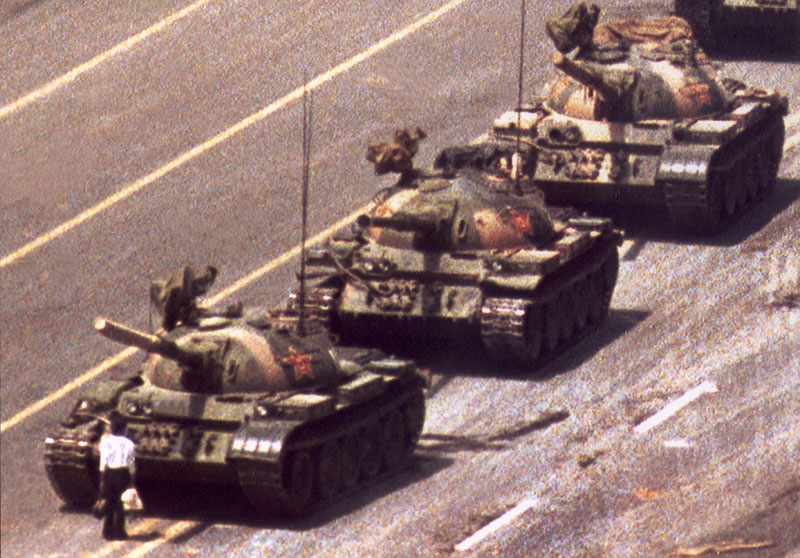
Tiananmen at 20


Twenty years ago today, Chinese students put their lives on the line to address the problems they saw in their society. Some called for democracy, some wanted an end to corrupt government, a few simply wanted to improve the quality of education they received. As we grumble about taking (and giving!) exams in this season, it is worth taking a moment to remember those who sacrificed to have the kinds of opportunities we enjoy.

Mr. Moyer sent around this excellent analysis about the legacy of the Tiananmen Square massacre, its impact on both modern China and on our understanding of modern China. If you want more information on Tiananmen, check out the resources here.


Tiananmen at Twenty
by Jeffrey Wasserstrom


In April and May of 1989, people around the world were inspired by the protests in Tiananmen Square, then horrified when the June 4 massacre turned Beijing streets into urban killing fields. China has changed enormously in the twenty years since then, but the Communist Party's attitude toward 1989 has remained constant. It insists there were no peaceful protests and no "massacre," just "counterrevolutionary riots" that were pacified by soldiers who showed great restraint. It refuses to acknowledge the losses to relatives of the hundreds of victims, tries to keep young Chinese ignorant of what happened and encourages specialists in the West to stop dwelling on 1989.

This approach is part of a larger effort to change the image of the party, so that mention of its name does not bring to mind visions of the Red Guard of the 1960s, anti-Confucian rallies of the '70s or the iconic picture of the lone man confronting a line of tanks. Instead, party leaders would like it to be associated with skyscrapers, sleek department stores and refurbished Confucian temples. These pictures fit in better with the party's view of itself as a pragmatic organization
that has moved China forward while honoring traditions, transformed cities into showplaces of modernity and raised the nation's international status and living standards. The 2008 Olympics, seen in this light, was the most expensive rebranding campaign in world history.

The regime's approach to 1989 is open to criticism on moral grounds. It is wrong to claim that the only martyrs of June 4 were a handful of soldiers attacked by crowds. And it is cruel to keep parents of victims from publicly mourning.

The party's version of post-1989 history can also be challenged. Consider, for example, how Perry Link, a leading China specialist, ends his May 17 Washington Post review of Prisoner of the State: The Secret Journal of Zhao Ziyang, the newly released posthumous memoir of the former party leader who was placed under house arrest for opposing the use of force in 1989. China's rulers "claim they have lifted millions from poverty," Link writes, "but in truth the millions have lifted themselves, through hard work and long hours, and in the process have catapulted the elite to unprecedented levels of opulence and economic power." Rejecting the notion that today's leaders are popular and firmly in control, he closes with this metaphor: "The seal continues to straddle the ball--insecure as ever, but still definitely on top."

These sentences are beautifully wrought. And though I think Link's circus analogy is misleading, I agree with his oft-stated insistence that China specialists need to resist the temptation to put 1989 behind us.

One reason to keep dwelling on 1989 is that common misunderstandings about that year persist, in China and in the West. For example, many Americans still think protesting students were the main victims of the massacre, even though the majority of the dead were workers who had turned out to support the educated youths. Many Americans also misremember those students as people who wanted to bring Western-style
democracy to China. The reality was much more complex.

The students did celebrate the virtues of minzhu (democracy), but they spent even more energy denouncing corruption. And while their outlook was cosmopolitan, they were intensely patriotic. They presented themselves as carrying forward a longstanding Chinese tradition: that of intellectuals speaking out against selfish officials whose actions were harming the nation. In addition, the students' grievances were not all purely political. They complained about the party's interferences in their private lives and about its failure to make good on economic
promises (Wuer Kaixi, a leader of the student movement, noted that a desire to be able to buy Nike shoes and other consumer goods was among the things that inspired members of his generation to act).

China specialists have another reason to revisit 1989: to stay humble. We pride ourselves on our deep understanding of China, but each of us was surprised by what happened twenty years ago--if not by the fact that a massacre occurred then by how long it took for the tanks to roll; if not by how many people risked their lives to fight for change then by the role rock music played in the protests.

It's also humbling to realize how often post-Tiananmen events have defied our predictions. More than a few observers assumed two decades ago that the Chinese Communist Party would soon go the way of its counterpart in Poland, where Solidarity won a major election on the very day of the massacre. Later, some of us were sure that to survive, the party would either pull back from engaging with the world or reverse the verdict on 1989.

China's rulers have instead combined rigidity about Tiananmen with startling flexibility on other fronts. To minimize the likelihood of a recurrence of 1989 and avoid succumbing to what some Chinese leaders call the "Polish disease" (a Solidarity-like movement), the party has encouraged consumerism (many youths can now buy those Nikes), pulled back from micromanaging campus life (today's students have much more personal freedom than their predecessors) and tried to leap ahead and
steer new outbursts of nationalism. It has also treated different kinds of protests in varying ways, using draconian measures to stop any struggle that seems highly organized or that could link people of different classes but showing leniency toward some single-class, single-locale actions. And while dissidents have found exciting uses for new technologies like the Internet and text-messaging, the regime has
also proved adept at using these media to discourage protests, disseminate its own interpretations of events and get supporters onto the streets.

How long can the regime keep expressions of discontent from snowballing again into something that threatens its power? This remains an open question, especially in light of the global economic downturn, which has not hit China as hard as it has many other countries but has led to a staggering number of factory closings and prompted an urban-to-rural migration of many workers who are not happy to be heading home. This is a phenomenon to watch, since economic frustrations were a crucial spur
to action in 1989 and are likely to figure centrally in the next big challenge the leadership faces from below.

For now, though, the long series of high-growth years provides the regime with a buffer, allowing many who are struggling to think they could do well in the future. The party's real difficulties will come when the memory of the recent upward surge has receded and a broad cross-section of people who have been left behind start to lose hope of prosperous times ahead. This is bound to happen eventually, but not yet.
And we should not underestimate the ability of this regime, which has been so effective at defying the odds, to further delay its long-predicted demise.

This is why I think that Perry Link has not quite hit the mark with his image of a seal balancing on a ball. This suggests a performance involving just one trick, whereas China's leaders are continually improvising. The circus act they bring to mind is not a seal but a juggler--the sort who somehow manages to keep a dizzying number of balls in the air, even when new objects are tossed into the rotation.


This article can be found on the web at:

http://www.thenation.com/doc/20090615/wasserstrom


Visit The Nation
http://www.thenation.com/

Subscribe to The Nation:
https://ssl.thenation.com/